Take the Biblical Support Challenge
Compare 90 of Joseph Smith’s teachings directly with the Bible and see how your beliefs align.
The Biblical Support Challenge
Before You Begin — A Quick Review
Before working through the full chart, consider this:
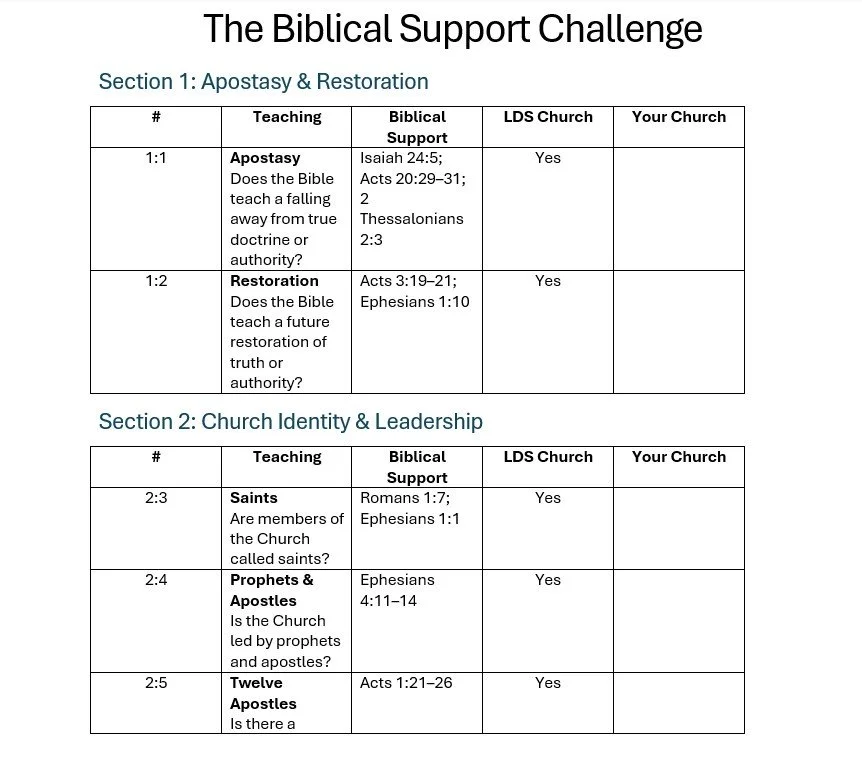
Across the following pages, you will examine 90 teachings and practices, each paired with biblical passages.
In my own study, I found that all 90 of these teachings can be supported using the Bible—when each passage is read in its plain and natural context.
But that’s not the conclusion I want you to accept.
It’s the claim I want you to test.
As you go through them, you may begin to notice a pattern:
Some teachings are clearly stated in the Bible
Some are interpreted from broader passages
Others may challenge what you’ve traditionally believed
By the end of this challenge, you won’t just have a score—you’ll have a clearer answer to a much bigger question:
Is your belief system built directly on what the Bible teaches… or on something else?
Introduction
By this point, you’ve seen the teachings, policies, and organization introduced by Joseph Smith. You’ve also seen the biblical passages that are often used to support them.
Now, I want to offer you a challenge—not a conclusion.
While interpretations of scripture can differ, many of the teachings presented are claimed to have biblical support. The question is: how well do they actually align with the Bible—and how does that compare to your own church or religious tradition?
Below is a chart listing key teachings and organizational elements, along with their proposed biblical support.
How to Complete the Challenge
Your task is simple:
Review each item carefully
Compare it with what your church or religious leaders teach
Mark “Yes” or “No” in the column labeled “Your Church”
At the end:
Count your total “Yes” answers
Divide by the total number of items
This will give you a percentage of how closely your church aligns with these biblical claims
How to Approach the Scriptures
As you work through these passages, remember:
Sincere believers may interpret scripture differently—but not all interpretations carry equal weight.
Start with the plain, natural meaning of the text—the way it would have been understood by its original audience.
Only interpret a passage symbolically when the context clearly requires it.
In most cases, the Bible communicates its message directly. So begin with what the text actually says before moving to what it might represent.
As you work through these passages, it’s important to recognize that sincere believers may interpret the same scripture differently. However, not all interpretations carry equal weight.
A helpful starting point is this: begin with the plain, natural meaning of the text—the way it would have been understood by its original audience. Only when the context clearly indicates symbolism, metaphor, or figurative language should a passage be interpreted that way.
In my own study, I’ve found that most biblical passages communicate straightforward ideas, while a smaller portion use symbolic or figurative language. That makes it essential to start with what the text actually says before moving to what it might represent.
The Real Question
As you complete this challenge, ask yourself:
Is your church teaching what the Bible clearly says—or something else?
The Biblical Support Challenge (Numbered Format)